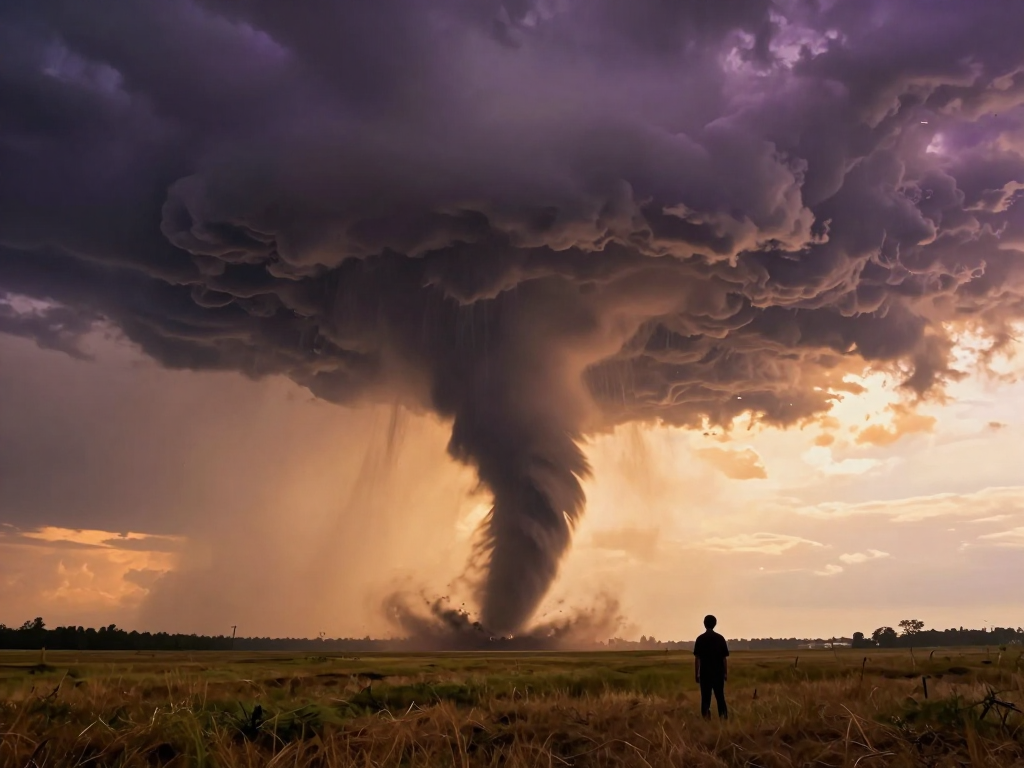
The sky darkens. The air goes still — that particular, terrible stillness that comes before everything changes. You look up and see it forming: a funnel descending from clouds that have turned the color of bruised metal. The tornado touches down, and the world explodes into motion. Debris spirals upward. The sound is like nothing you have heard — a freight train, a roar, a vibration that seems to come from inside your own body. You run, or you freeze, or you watch in awe, or you are swept up into it. And then you wake, heart pounding, the phantom wind still ringing in your ears.
Tornado dreams are among the most physically intense dreams people report. They engage the body as well as the mind — dreamers frequently wake with elevated heart rate, sweating, and a visceral sense of having been through something real. This intensity is not accidental. The tornado is one of the most powerful symbols the unconscious can deploy, and it appears when the psyche needs to communicate something urgent about the dreamer's emotional landscape.
The Core Symbolism of Tornadoes in Dreams
At its most fundamental, a tornado in a dream represents overwhelming emotional energy — feelings so powerful that they threaten to destroy the structures of your normal life. The tornado is not a random image; it is a precise metaphor for emotional force that has built up beyond containment. Just as a real tornado forms when atmospheric conditions create an unsustainable imbalance — warm air trapped beneath cold, pressure building until it explodes into rotational violence — a dream tornado forms when emotional pressure has built up beyond the psyche's ability to contain it.
The key emotions that generate tornado dreams are anger, anxiety, and grief — the three feelings most commonly suppressed in modern life. If you have been pushing down rage at an unfair situation, swallowing anxiety about an uncertain future, or refusing to fully grieve a loss, the emotional energy does not disappear. It accumulates. And when it reaches a critical mass, your dreaming mind gives it the most appropriate form it can find: a force of nature that cannot be reasoned with, cannot be stopped, and will tear apart anything that is not built on a solid foundation.
Tornadoes also represent sudden, radical change. Not the gradual, managed kind of change — the kind that arrives without warning and rearranges everything. A tornado dream may appear before, during, or after a major life upheaval: job loss, relationship breakdown, diagnosis, relocation, or any event that has fundamentally altered the landscape of your life. The tornado embodies the experience of change that feels destructive while it is happening but may ultimately clear away structures that were already failing.
Control — or more precisely, the loss of it — is central to tornado symbolism. Tornadoes cannot be controlled, redirected, or stopped. You can only take shelter and wait for them to pass. If you are someone who relies heavily on control as a coping mechanism — controlling your environment, your schedule, your relationships, your emotions — a tornado dream may be your psyche's way of confronting you with the reality that some forces in life are beyond your ability to manage. The dream asks: what happens when you cannot control what is coming?
What the Tornado's Behavior Reveals
A tornado in the distance — You can see it but it has not reached you yet. This typically represents awareness of approaching emotional upheaval or change. You sense that something disruptive is coming — a confrontation, a decision, a revelation — but it has not yet arrived. The distance between you and the tornado in the dream often correlates to how far away the anticipated disruption feels in waking life. This dream is both a warning and an opportunity: you still have time to prepare.
A tornado chasing you — This is one of the most anxiety-producing dream scenarios and suggests that you are actively running from emotional confrontation. The feelings the tornado represents — anger, grief, anxiety, fear of change — are pursuing you because you are refusing to turn and face them. The harder you run in the dream, the more energy you are spending in waking life on avoidance. These dreams often escalate in intensity until the dreamer either faces the tornado in the dream or addresses the underlying emotional issue in waking life.
Multiple tornadoes — Dreaming of several tornadoes at once suggests that you are dealing with multiple simultaneous sources of emotional overwhelm. Each tornado may represent a different problem, conflict, or area of life that feels chaotic and uncontrollable. Multiple tornadoes often appear in the dreams of people experiencing compound stress — when it is not one thing going wrong but several things at once, and the dreamer feels surrounded by crises.
Being inside the tornado — This paradoxical dream scenario is more common than you might expect, and its meaning is distinct from being chased. Being inside the tornado — in its eye or swept up in its rotation — often represents being in the middle of a major life transition. You are already inside the change. The destruction is happening around you, but you are surviving it. These dreams, while terrifying, can actually be positive indicators: they suggest that you are moving through the upheaval rather than being destroyed by it. Many people report a strange calm in the eye of the dream tornado — this reflects the psychological truth that once you stop resisting change and surrender to it, the anxiety often decreases even though the external situation has not improved.
A tornado that destroys your home — The home represents the self, so a tornado destroying your home represents a fundamental disruption to your sense of identity, security, or psychological foundation. This dream is serious and typically appears during or after events that have genuinely shaken your foundational sense of who you are: divorce, betrayal, loss of a parent, a crisis of faith, or a career collapse. The dream is not predicting destruction — it is processing destruction that has already occurred or that the psyche senses is imminent.
A tornado that passes without causing damage — This is a surprisingly positive dream. You saw the tornado, you felt the fear, but it moved past without destroying anything. This suggests that a feared upheaval will be less devastating than anticipated, or that you are better prepared for coming change than you believe. It may also indicate that the emotional pressure that was building has found another outlet — you may have processed the feelings through conversation, creative expression, physical activity, or other healthy channels, and the tornado of suppressed emotion has dissipated.
Surviving the tornado — Dreams in which you survive the tornado and emerge to survey the aftermath are among the most psychologically significant. The aftermath landscape — what was destroyed and what survived — is a map of your psychological resilience. Buildings that survived represent aspects of your life and identity that are built on solid foundations. Debris represents what was not structurally sound and has been cleared away. These post-tornado dreams are the psyche's way of showing you that you have survived something difficult and that what remains is what truly matters.
The Emotional Weather Report
One of the most useful frameworks for understanding tornado dreams is to treat them as emotional weather reports. Just as real weather systems are neutral physical phenomena — neither good nor evil, just energy moving through the atmosphere — dream tornadoes are neutral psychological phenomena: they represent emotional energy moving through the psyche. The tornado itself is not your enemy. It is your own emotional energy in its most raw, uncontrolled form.
This reframing is powerful because it shifts the question from "how do I avoid the tornado?" to "what emotional energy is building up that needs to move?" The tornado is not attacking you — it is you. It is the anger you have not expressed, the grief you have not cried, the anxiety you have not acknowledged, the desire for change you have not admitted. The tornado destroys, yes — but what it destroys are often the structures (beliefs, habits, relationships, self-images) that were already failing and that needed to be cleared away for something new to be built.
Cultural Perspectives
In Native American dream traditions, particularly among Plains tribes who lived in tornado-prone regions, tornado dreams were understood as encounters with powerful spirit forces. The tornado was not merely a weather event but a manifestation of spiritual energy — sometimes destructive, sometimes transformative, always demanding respect. A tornado dream might indicate that the dreamer was being called to a spiritual path or that powerful forces were at work in their life that required ceremonial attention.
In Jungian psychology, the tornado is understood as an eruption of unconscious content into consciousness. The rotational energy of the tornado mirrors the spiraling, circular nature of unconscious processes — material that cycles beneath the surface, building energy, until it breaks through with destructive force. Jung would interpret a tornado dream as the unconscious demanding integration: repressed material that can no longer be contained and that will force its way into awareness whether the ego cooperates or not.
In Chinese dream interpretation, tornadoes and whirlwinds are often associated with the concept of qi (life energy) in its most violent and imbalanced form. A tornado dream may indicate a severe imbalance in the dreamer's life energy — too much fire (anger), too much water (grief), or a blockage that has caused energy to spiral destructively rather than flow harmoniously. The prescription is typically to seek balance through practices that restore energetic flow.
In Islamic dream interpretation, strong winds and storms can represent trials sent by God, and the dreamer's response to the storm — whether they seek shelter, stand firm, or are swept away — reveals their spiritual preparedness for life's inevitable tests.
The Twist — What Most People Miss About Tornado Dreams
Here is the insight that transforms tornado dream interpretation: the tornado is not something that is happening to you — it is something that is happening within you. The emotional energy the tornado represents is your own energy. And the single most important detail in any tornado dream is not the tornado itself but your response to it.
Do you run? Then you are running from your own emotions in waking life. Do you take shelter? Then you are protecting yourself — which may be wise or may be avoidance, depending on whether the shelter holds or collapses. Do you watch in fascination? Then some part of you is drawn to the power of the emotional energy, perhaps recognizing that the change the tornado brings is necessary. Do you try to save others? Then you may be focusing on other people's emotional crises to avoid your own. Do you get swept up and survive? Then you are moving through the emotional storm and discovering that you are more resilient than you feared.
The second key insight: tornado dreams often decrease in frequency and intensity once the dreamer begins to consciously address the emotions the tornado represents. If you have recurring tornado dreams, they are almost certainly connected to a specific emotional pattern in your waking life. Identifying and addressing that pattern — expressing the anger, processing the grief, confronting the anxiety, making the change you have been avoiding — typically causes the tornado dreams to subside. The tornado served its purpose: it got your attention.
What to Do When You Dream About a Tornado
First, note your emotional response during the dream — not just the tornado, but your specific feelings and actions. Were you terrified, calm, excited, frozen, determined? Your response reveals your current relationship with the emotional energy the tornado represents.
Second, note what the tornado destroyed and what survived. This is the diagnostic information: what in your life is structurally sound and what is vulnerable to upheaval?
Third, ask yourself honestly: what emotional energy have I been suppressing? What feelings have been building up? What change have I been resisting? The answer to these questions is likely the raw material from which the tornado was formed.
Fourth, consider the timing. Has there been a recent event, decision, or confrontation that might have generated the emotional pressure? Tornado dreams rarely appear in calm periods — they are almost always connected to a specific waking-life trigger.
Fifth, if the tornado is recurring, take it seriously. Recurring tornado dreams are among the most insistent signals the unconscious can send. They will escalate in intensity until the underlying emotional pattern is addressed.
What Our AI Dream Interpreter Says
Tornado dreams are among the highest-urgency entries our AI interpreter processes, because they almost always indicate significant emotional pressure that needs conscious attention. When a user logs a tornado dream, the AI evaluates: the tornado's size, number, proximity, path, destructiveness, and the dreamer's response. One user dreamed of a massive tornado destroying their workplace while they watched from a hill. The AI interpreted this as deeply suppressed frustration with a work situation — the dreamer wanted to see the professional structures torn down but felt guilty about the desire, so the unconscious outsourced the destruction to a natural force beyond the dreamer's control. The user later acknowledged that they had been unhappy at work for over a year and had been avoiding the decision to leave. Another user logged three tornado dreams in two weeks, each more intense than the last. The AI flagged the escalating pattern and identified it as unprocessed grief from a parent's death six months earlier — grief that the user had intellectualized but never emotionally processed. Following the interpretation, the user began grief counseling, and the tornado dreams stopped within a month.
When to Pay Attention
All tornado dreams deserve attention, but certain patterns are particularly significant. If you have tornado dreams more than twice a month, this suggests chronic emotional pressure that needs an outlet. If the tornadoes are getting larger, closer, or more destructive across dreams, the emotional pattern is escalating and the need for attention is becoming urgent. If tornado dreams are accompanied by waking symptoms of anxiety — difficulty sleeping, racing thoughts, physical tension, irritability — the emotional energy the tornado represents may be affecting your daily functioning, and professional support could be beneficial.
The tornado in your dream is not your enemy. It is your own power — emotional energy so vast and concentrated that it frightens even you. The question is not how to stop it but how to listen to what it is telling you. What needs to change? What needs to be released? What structures in your life can no longer withstand the pressure of who you are becoming? The tornado knows the answers. Your job is to stop running long enough to hear them.