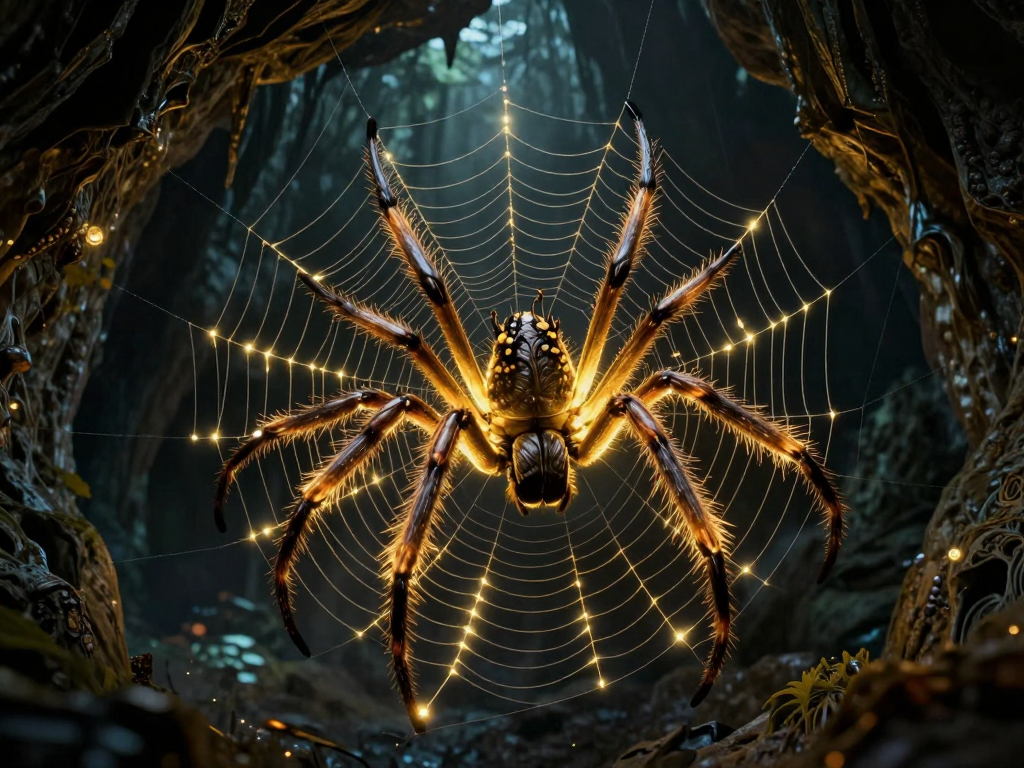
There it is — a spider. Maybe it is small and delicate, spinning a web in the corner of a room you do not recognize. Maybe it is enormous, black, and terrifyingly close. Maybe there are hundreds of them, crawling across walls, dropping from ceilings, covering the floor in a living carpet of legs. You freeze, you scream, you try to brush them off — or perhaps you simply watch, fascinated, as the spider weaves its intricate web. Whatever the scenario, you wake up and the image stays with you, vivid and visceral.
Spider dreams are among the most emotionally charged dream experiences reported to psychologists and dream researchers. They provoke reactions that range from intense fear to quiet awe, and their interpretation spans an equally wide spectrum — from phobia processing to creative awakening. Understanding the spider dream meaning requires looking beyond the initial emotional reaction and exploring the rich symbolic territory that spiders have occupied in human culture for thousands of years.
Why Spider Dreams Are So Common
Arachnophobia — the fear of spiders — is one of the most prevalent phobias worldwide, affecting an estimated 3 to 15 percent of the population. But spider dreams are far more common than arachnophobia, appearing in the dreams of people who have no particular fear of spiders in waking life. Research from the dream labs at the University of Zurich found that arthropods, including spiders, appear in approximately 10 percent of recalled dreams, making them one of the most common animal symbols in the dream world.
The reason is evolutionary and symbolic. Spiders have been part of the human environment since prehistory, and our brains are primed to notice them — a phenomenon psychologists call prepared learning. We are biologically predisposed to be alert to spiders because, in our evolutionary past, some species posed genuine dangers. This neurological sensitivity translates into dream content: the brain, drawing on its most emotionally salient material during sleep, frequently casts the spider in a leading role.
But the spider is also one of the most symbolically rich creatures in human mythology. Spiders weave, create, trap, wait, and transform. They are simultaneously feared and revered across cultures. This symbolic density is precisely what makes spider dreams so complex — and so rewarding to interpret.
6 Key Meanings of Spiders in Dreams
1. Creativity and Creation — The spider is, above all, a creator. The web it spins is one of nature's most remarkable constructions — geometrically precise, functionally brilliant, and crafted from material the spider produces from its own body. Dreaming of a spider spinning a web often symbolizes your own creative process. You may be in a phase of building something — a project, a business, a relationship, a work of art — and the spider represents the creative intelligence that weaves disparate elements into a cohesive whole. If the web is beautiful and complete, your creative work may be progressing well. If it is torn or incomplete, you may feel that your creative vision is being disrupted or that the project requires repair.
2. Feminine Power and the Great Mother — In Jungian psychology and across mythological traditions, the spider is profoundly connected to feminine energy. The Greek myth of Arachne — a mortal weaver transformed into a spider by the goddess Athena — links spiders to female skill, pride, and creative power. In many Native American traditions, Spider Woman (Spider Grandmother) is the creator of the world, weaving reality itself into existence. In Hindu mythology, the spider represents Maya — the illusion of the material world, woven like a web. Dreaming of a spider can represent the feminine principle in your psyche — creativity, intuition, patience, and the power to create and sustain life. For women, spider dreams may connect to their own feminine power. For men, the spider may represent the anima — the feminine aspect of the male psyche — seeking recognition.
3. Fear and Anxiety — For many dreamers, a spider dream is simply about fear. If you have arachnophobia or a strong discomfort with spiders, the dream may be your brain processing this specific fear during sleep. But even for people who are not particularly afraid of spiders in waking life, a spider dream can symbolize anxiety — particularly anxiety about something that feels threatening, invasive, or difficult to control. The spider's ability to appear suddenly, to move in unexpected ways, and to trap its prey mirrors the unpredictable, entrapping quality of anxiety itself.
4. Control and Manipulation — The spider's web is a trap. It looks beautiful, but its purpose is to catch, hold, and consume. Dreaming of a spider and its web can represent situations in your life where you feel trapped or manipulated — or where you yourself are the one weaving a web of control. Ask yourself: am I the spider or the fly? If you feel caught in someone else's web, the dream may reflect a manipulative relationship, a controlling work environment, or a situation where you feel entangled in obligations or deceptions. If you are the spider, the dream may be reflecting your own need for control — and questioning whether that control comes at a cost.
5. Patience and Strategy — Spiders do not chase their prey. They build their web and wait. This makes the spider a powerful symbol of patience, strategic thinking, and trust in the process. If you dream of a spider calmly sitting in the center of its web, your subconscious may be telling you that the situation requires patience rather than action — that the web has been woven, the trap has been set, and now you need to wait for the right moment. This interpretation is particularly relevant for people navigating complex professional or personal situations that require strategic patience rather than impulsive action.
6. Shadow and the Repulsive — Spiders provoke disgust and fear in many people, and in Jungian terms, they can represent the Shadow — the rejected, repulsive aspects of the self that the ego does not want to acknowledge. A spider dream, especially one involving intense revulsion, may be inviting you to examine what you find repulsive about yourself or others — and to consider whether that repulsion is masking something that, if acknowledged, could be integrated and transformed. The spider is not evil; it is performing its nature. What aspect of your own nature are you rejecting?
Cultural Perspectives
In West African and Caribbean folklore, Anansi the spider is a trickster figure — clever, witty, and able to outsmart much larger opponents through intelligence and cunning. Dreaming of a spider in traditions influenced by Anansi stories may represent the need for cleverness, resourcefulness, and using wit rather than force to navigate a challenging situation.
In Japanese culture, the spider (kumo) carries dual symbolism. During the day, a spider is considered a bringer of good fortune. At night, however, a spider is feared — associated with shape-shifting demons (jorougumo) that take the form of beautiful women to lure victims. Spider dreams in Japanese tradition are thus interpreted in the context of when they occur and the spider's behavior.
In many Native American traditions, Spider Woman is a creator deity who wove the world into being and continues to connect all living things through her web. Dreaming of a spider in these traditions can be a deeply spiritual experience — a message from the creator about interconnectedness, creative purpose, and the web of life that binds all beings.
In European folklore, killing a spider was considered bad luck — sometimes catastrophically so. The superstition "If you wish to live and thrive, let the spider run alive" reflects a cultural ambivalence: spiders are feared but also respected as symbols of industry, patience, and good fortune. The famous story of Robert the Bruce, inspired by a spider's persistence in weaving its web, links the spider to perseverance and never giving up.
What Psychology Says
Freud interpreted spider dreams primarily through the lens of the mother complex. For Freud, the spider — particularly the large, dominant spider — represented the controlling, devouring mother. The web was the mother's sphere of influence from which the child cannot escape. While this interpretation may seem dated, it retains relevance for dreamers whose relationships with their mothers are complex, enmeshed, or characterized by a feeling of being controlled or consumed.
Jung viewed the spider as an archetype of the Great Mother and the creative feminine. He also connected the spider to the concept of the web of fate — the interconnected threads of destiny that link all events and people. For Jung, a spider dream could represent the dreamer's relationship with fate, creativity, and the feminine unconscious. He encouraged dreamers to pay attention to whether they feared or admired the spider, as this reaction revealed their relationship with the creative and feminine aspects of their own psyche.
Modern cognitive psychology approaches spider dreams through the threat simulation model and through research on specific phobia processing. Studies have shown that people with arachnophobia dream about spiders more frequently, and that these dreams may actually serve a therapeutic function — gradually desensitizing the dreamer to the feared stimulus through repeated nocturnal exposure. For non-phobic dreamers, cognitive psychology emphasizes the importance of personal association: what spiders mean to you specifically is more important than any universal symbol dictionary.
Common Scenarios
A spider spinning a web — This is typically a creative and positive dream. The spider is building, creating, and producing something beautiful and functional from its own resources. It often reflects a period of creative productivity or the development of a plan that is coming together piece by piece.
Being bitten by a spider — A spider bite in a dream often represents a wake-up call or a sudden realization. Something has pierced your defenses and injected its venom — an uncomfortable truth, a betrayal, or a situation that has suddenly turned toxic. The location of the bite can offer additional meaning: a bite on the hand suggests creative or work-related issues; a bite near the heart suggests emotional hurt.
Giant spiders — Oversized spiders in dreams amplify whatever the spider symbolizes. If the spider represents fear, a giant spider represents overwhelming fear. If the spider represents creative power, a giant spider represents immense creative potential. The dreamer's emotional response to the giant spider is the key to determining which interpretation applies.
Many spiders or spiders covering your body — This intensely uncomfortable dream often reflects feeling overwhelmed by many small anxieties, obligations, or irritations. Each spider represents a separate concern, and together they create a sense of being overrun and unable to cope. It can also represent a skin-crawling awareness that something in your environment is fundamentally wrong — a situation that gives you the creeps for reasons you cannot quite articulate.
Killing a spider — Killing a spider in a dream can represent destroying something creative, feminine, or patient in yourself — squashing an idea, ending a creative project, or suppressing your intuition. Alternatively, it can represent overcoming a fear or eliminating something that has been entrapping you. The dreamer's feeling after killing the spider — relief or regret — indicates which interpretation is more accurate.
What Our AI Dream Interpreter Says
Spider dreams generate some of the most emotionally diverse entries in our dream journal app, and our AI interpreter has developed a nuanced framework for analyzing them. The AI evaluates six dimensions: the size and type of spider, the spider's behavior (spinning, biting, watching, crawling), the dreamer's emotional response (fear, fascination, disgust, calm), the dream setting (home, outdoors, unfamiliar location), the presence or absence of a web, and the dreamer's waking-life associations with spiders. One user dreamed of a golden spider spinning an enormous web between two trees at sunrise; the AI identified this as a profoundly creative dream, connecting the golden color to value and the sunrise to new beginnings, and interpreted the dream as the user's subconscious affirming a creative project they had been hesitant to begin. Another user dreamed of finding hundreds of tiny spiders in their bed; the interpreter analyzed the bed as a symbol of intimacy and vulnerability, and the many small spiders as numerous small anxieties about a new romantic relationship that were collectively making the user feel unable to relax into emotional intimacy. Our AI dream interpreter recognizes that spider dreams sit at the intersection of fear and fascination — and that the dreamer's relationship to the spider reveals as much as the spider itself.
When to Be Concerned
Spider dreams are normal and psychologically healthy, even when they are frightening. However, certain patterns deserve attention. If spider dreams are accompanied by severe arachnophobia that limits your daily functioning — avoiding certain rooms, refusing to go outdoors, experiencing panic attacks at the sight or thought of spiders — the phobia itself may benefit from professional treatment such as exposure therapy or cognitive-behavioral therapy. If spider dreams become recurrent and increasingly distressing, particularly if they involve themes of being trapped, consumed, or overwhelmed, they may be reflecting an underlying anxiety disorder or a specific life situation — such as a controlling relationship or a toxic work environment — that requires attention. If the spider dreams involve sensations of insects crawling on your skin that persist after waking (formication), consult a medical professional, as this can be associated with certain medical or neurological conditions.
The spider in your dream is not simply a creature — it is a mirror. It reflects your relationship with creativity, power, fear, femininity, patience, and control. It asks you to examine your own web: the one you have woven around yourself, the one you are caught in, or the one you are only beginning to spin. The next time a spider appears in your dream, resist the impulse to recoil. Look at it. What is it doing? How do you feel about it? Is it building or trapping? Is it patient or menacing? Your answers will tell you something important about the intricate, beautiful, sometimes terrifying web of your own inner life.