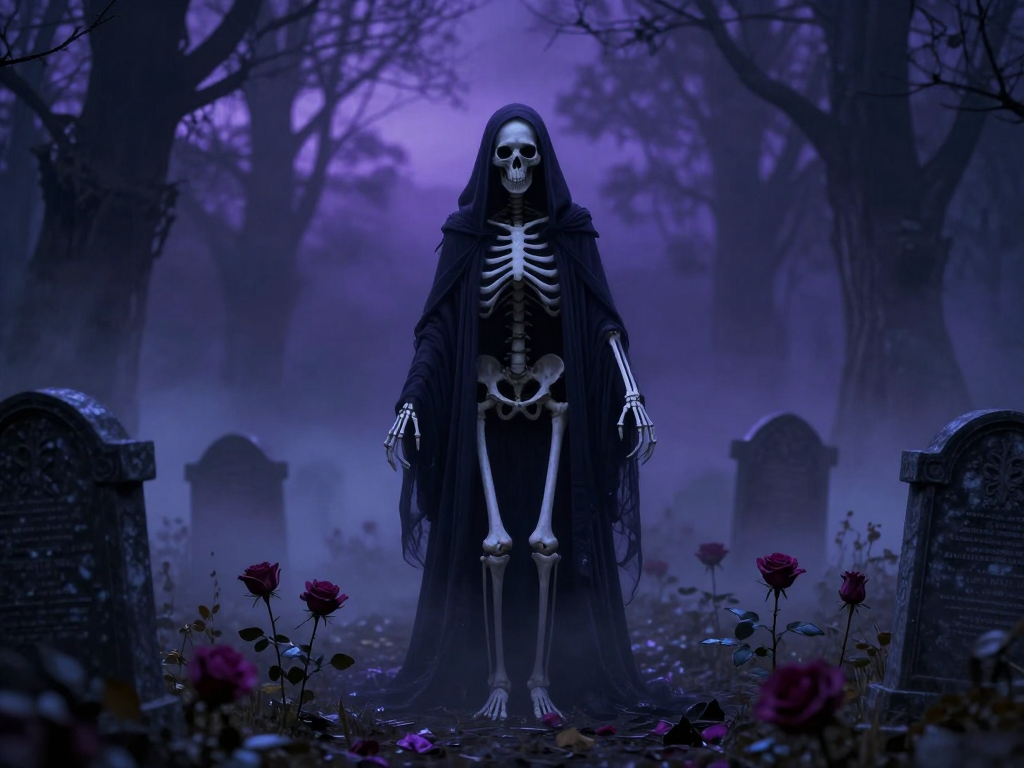
You dream that you die. Or maybe someone you love dies. Or perhaps death is just there — a presence, a shadow, an ending you can feel but cannot see. You wake up shaken, disoriented, gripped by a dread that takes minutes to shake off. Your first instinct is to worry: is this a premonition? Is something wrong? Is this dream trying to warn me about something terrible?
Take a breath. Dreaming about death is one of the most common and most misunderstood dream experiences. While the emotional impact is undeniable, the death dream meaning is almost never literal. Death in dreams is the mind's most dramatic symbol — and it speaks not of endings, but of transformation.
The Death Dream: Why It Is So Common
Death dreams appear in virtually every study of common dream themes. Research from the American Psychological Association places death-related dreams among the top ten most frequently reported, alongside being chased, falling, and teeth falling out. A large-scale survey by the Dream Research Institute found that approximately 50 percent of adults have dreamed about their own death at least once, and an even higher percentage have dreamed about the death of someone they know.
The prevalence of death dreams is not morbid — it is logical. Death is the one certainty of human existence, the ultimate unknown, and the subject that provokes our deepest fears and our most profound philosophical questions. The dreaming brain, which processes emotion and consolidates meaning during sleep, naturally returns to this theme again and again. It is not that something is wrong with you for dreaming about death; it is that you are human.
7 Common Meanings of Death Dreams
1. Transformation and New Beginnings — The most widely accepted death dream meaning is transformation. In dream symbolism, death rarely represents physical death. Instead, it signifies the end of one chapter and the beginning of another. You may be leaving behind an old version of yourself — an outdated belief, a former identity, a way of life that no longer serves you. The dream marks the threshold between who you were and who you are becoming.
2. Fear of Loss — Dreaming about the death of a loved one often reflects the fear of losing them rather than any actual prediction. If you dream that your partner, parent, child, or friend dies, your subconscious may be processing anxiety about the relationship — fear of growing apart, fear of their aging, or fear of an emotional disconnection that feels like a kind of death.
3. Unresolved Grief — If you have lost someone in real life, death dreams can be part of the grieving process. The dream may replay the loss, alter the circumstances, or even allow you to say goodbye in a way you could not in waking life. These dreams, while painful, are often considered healing by grief therapists — they are the psyche's way of working through what it has not yet fully processed.
4. Anxiety About Your Own Mortality — Sometimes the death dream meaning is straightforward: you are confronting your own mortality. This is particularly common during midlife, after a health scare, after losing someone your own age, or during existential periods of questioning the meaning of life. The dream is not a premonition; it is an acknowledgment of the fact that life is finite — and often a catalyst for living more intentionally.
5. Ending of a Relationship or Phase — Death in a dream can represent the death of a relationship, a career, a friendship, or a phase of life. If you dream about an ex-partner dying, it may signify that you are finally letting go of that relationship emotionally. If you dream about a work colleague dying, it may reflect the end of a professional chapter. The death is symbolic: something in your life is over, and your subconscious is processing the finality.
6. Repressed Anger or Resentment — This interpretation is uncomfortable but important. Occasionally, dreaming about someone's death reflects unexpressed anger or resentment toward that person. This does not mean you wish them harm — it means you have strong unprocessed emotions about them that your subconscious is dramatizing in the most extreme way possible. The dream is a signal to examine the relationship and address what has been left unsaid.
7. A Call to Wake Up — Death in a dream can serve as a powerful wake-up call from your subconscious. If you have been sleepwalking through life — going through the motions, ignoring your passions, numbing yourself with routine — a death dream can jolt you into awareness. The message is visceral and urgent: life is short, and you are not living it fully. Change something.
Cultural Perspectives
In Western culture, death dreams are typically feared and interpreted negatively, reflecting the broader cultural discomfort with death as a topic. Modern Western dream analysis frames death dreams as psychological metaphors for change and transition.
In many Eastern traditions, death in dreams carries a more neutral or even positive connotation. In Tibetan Buddhism, dreaming of death is considered a rehearsal for the bardo — the transitional state between death and rebirth — and is viewed as an opportunity for spiritual practice. In Hindu tradition, dreaming of death can symbolize the destruction of ego and the liberation of the soul (moksha).
In Islamic dream interpretation, the death dream meaning varies by context. Dreaming of one's own death can signify a long life, repentance, or a spiritual journey. Dreaming of a dead person who appears alive can be a message from the deceased or a reflection of their status in the afterlife. The overall emotional tone of the dream is considered crucial.
In many African and indigenous traditions, death dreams are understood as communication with the ancestral realm. The dead in dreams are not gone but present in a different form, offering guidance, warnings, or blessings. These dreams are treated with deep respect and are often shared with community elders for interpretation.
What Psychology Says
Freud viewed death dreams as fulfillment of unconscious wishes — not necessarily the wish for someone to die, but the wish for change, release, or resolution of conflict. He also connected death dreams to the concept of Thanatos, the death drive, which he saw as a fundamental force in the human psyche alongside Eros, the life drive.
Jung interpreted death in dreams as the most powerful symbol of psychological transformation. For Jung, the death of a figure in a dream represents the death of an aspect of the psyche — a persona, a complex, an outdated attitude. It is the necessary destruction that precedes new creation. The death is not something to fear but something to embrace as evidence of psychological growth.
Modern neuroscience approaches death dreams through the lens of emotional processing. Research has shown that the brain uses dreams to process emotionally charged experiences, and few experiences carry more emotional charge than the concept of death. Studies using brain imaging have shown that death dreams activate the same neural regions as real grief and fear, which is why they feel so viscerally real upon waking. However, research also shows that people who allow themselves to sit with death dreams — rather than suppressing them — report greater psychological resilience and a more nuanced relationship with mortality.
Common Scenarios
Dreaming of your own death — Dreaming that you die is paradoxically one of the most positive death dream scenarios. It almost always symbolizes transformation — the old you is dying to make room for the new you. It often appears during major life transitions: starting a new career, becoming a parent, moving to a new city, or undergoing a significant inner shift.
Dreaming of a loved one dying — This is typically the most distressing death dream. It usually reflects fear of loss, dependency anxiety, or concern about the relationship rather than any literal prediction. If the loved one is elderly or ill, the dream may be your psyche's way of pre-processing grief — preparing you emotionally for an eventuality you cannot control.
Dreaming of a dead person being alive — Known as visitation dreams, these experiences often feel qualitatively different from ordinary dreams — more vivid, more peaceful, more real. Many people report conversations with deceased loved ones that feel genuine rather than dreamlike. Whether interpreted as spiritual visitation or the brain's way of maintaining emotional bonds, these dreams are consistently reported as comforting and healing.
Attending a funeral in a dream — Dreaming of a funeral often represents closure. You are laying something to rest — a grudge, a regret, a past version of yourself. The funeral is not about death but about acknowledgment: you are recognizing that something has ended and giving yourself permission to move on.
What Our AI Dream Interpreter Says
Death dreams are among the most emotionally charged entries in our app, and our AI interpreter approaches them with the sensitivity and depth they require. When a user logs a death dream, the AI examines the full emotional landscape: who died, how they died, how the dreamer felt, and what else was happening in the dream. One user dreamed of their own death in a hospital and felt not fear but relief; the AI identified the dream as a desire to release an exhausting phase of life and embrace rest and renewal. Another user repeatedly dreamed of a deceased grandmother speaking to them; the interpreter analyzed the content of the conversations across multiple dreams and identified a pattern of guidance related to a specific life decision the user was struggling with. Our AI dream interpreter understands that death dreams are not one-dimensional — they are layered with personal history, cultural context, and emotional nuance that requires careful, individualized analysis.
When to Be Concerned
Death dreams are normal and psychologically healthy. However, there are situations where they warrant attention. If you are experiencing recurring death dreams accompanied by suicidal thoughts, pervasive hopelessness, or a desire to not wake up, this is a signal to seek professional support immediately. Frequent, distressing death dreams can also be a symptom of PTSD, particularly in people who have witnessed death or experienced trauma. If death dreams are accompanied by prolonged grief that interferes with daily functioning — months or years after a loss — a grief therapist can provide specialized support.
Death in dreams is one of the most profound messages your subconscious can deliver. It speaks of endings that are also beginnings, of losses that create space for gain, of the perpetual cycle of destruction and creation that defines all growth. The next time you dream of death, do not push it away. Sit with it. Write it down. Ask yourself: what is ending in my life? What needs to end? And what is ready to be born in its place? Your dreaming mind has confronted the ultimate human truth — mortality — and transformed it into a symbol of change. That is not something to fear. That is wisdom.