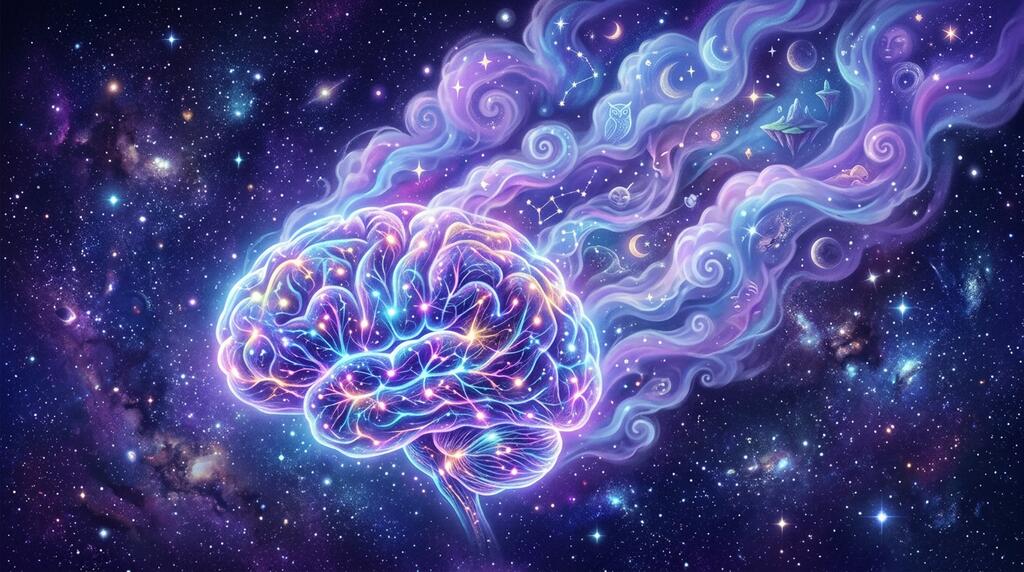
Humans have been asking why we dream for thousands of years, and modern science is still uncovering the answer. Rather than a single explanation, current research suggests dreams serve multiple vital functions simultaneously.
The activation-synthesis theory, proposed by Harvard psychiatrists Hobson and McCarley, suggests dreams are the brain's attempt to make sense of random neural activity during sleep. As your brainstem sends random electrical signals during REM sleep, your cortex weaves these signals into narratives — creating the strange, associative quality of dreams. However, this theory doesn't explain why dreams have recurring themes or emotional coherence.
The threat simulation theory offers an evolutionary perspective. Dreams evolved as a safe environment to practice responses to dangerous situations. This explains why negative dreams are more common than positive ones — your brain is rehearsing survival scenarios. Chased in a dream? Your threat detection system is running drills. This theory is supported by evidence that people who experienced more real-world threats tend to have more threat-simulation dreams.
Memory consolidation is perhaps the most well-supported function of dreaming. During sleep, your brain replays and reorganizes the day's experiences, strengthening important memories and discarding trivial ones. Dreams may be the subjective experience of this process. Studies show that people who dream about newly learned material perform better on tests of that material — suggesting dreams actively participate in learning.
Emotional regulation is another critical function. REM sleep acts as overnight therapy, processing emotional experiences and reducing their intensity. Matthew Walker's research at UC Berkeley demonstrates that dreaming about emotional events strips the raw emotional charge from memories while preserving the informational content. People deprived of REM sleep show increased emotional reactivity and poorer emotional regulation.
The problem-solving function of dreams has been documented throughout history. The discovery of the benzene ring structure, the invention of the sewing machine needle, and Paul McCartney's composition of "Yesterday" all reportedly originated in dreams. During dreaming, your brain makes connections between seemingly unrelated concepts, often producing creative solutions that elude waking logic.
Social simulation theory proposes that dreams help us navigate complex social relationships. Many dreams feature social scenarios — conflicts, romantic encounters, family dynamics — that may serve as practice for real social situations. This theory explains why our dreams so heavily feature people we know and social interactions.
The self-model theory suggests dreams serve a maintenance function for our sense of identity. By constantly generating scenarios and testing our responses, dreams help maintain and update our model of who we are, what we value, and how we relate to the world.
Most neuroscientists now believe dreams serve all of these functions and more, with different types of dreams serving different purposes. A nightmare might serve threat simulation, while a dream about your workday consolidates procedural memories, and a strange symbolic dream processes deep emotional material.
What's remarkable is that regardless of the mechanism, every human culture has recognized dreams as meaningful. Whether viewed through a scientific, psychological, or spiritual lens, dreams represent a fundamental aspect of human consciousness that we're only beginning to understand.